November 26, 2025
Mastering Predictive Maintenance: A Deep Dive into Technology and Strategy-Based Types

Unplanned downtime costs the global economy $50 billion annually, yet most organizations still rely on reactive maintenance or rigid preventive maintenance schedules that miss critical equipment failures. Predictive maintenance offers a data-driven solution, but understanding the various types of predictive maintenance is crucial for selecting the right approach for your facility.
Predictive maintenance encompasses twelve distinct approaches organized into two main categories: technology-based types that use specific sensors and analytical methods, and strategy-based types that define when and how maintenance interventions occur. This comprehensive guide explores each type, providing the cost data, implementation requirements, and selection criteria maintenance teams need to optimize equipment reliability while minimizing maintenance costs.
Whether you’re managing rotating machinery in a manufacturing plant or electrical systems in the oil and gas industry, understanding these types of predictive will help you move beyond reactive maintenance toward a proactive maintenance strategy that prevents equipment failures before they occur.
Overview of Predictive Maintenance Types
The landscape of predictive maintenance technologies and strategies has evolved significantly from simple vibration analysis to sophisticated machine learning algorithms that process real time sensor data. Today’s maintenance professionals can choose from eight primary technology-based types of predictive maintenance including vibration analysis, oil analysis, thermography, and acoustic monitoring, each designed to detect specific failure modes in mechanical equipment.

These technology-focused approaches work alongside four strategy-based maintenance approaches: condition based maintenance, risk-based, corrective, and predetermined maintenance. While technology types focus on specific monitoring methods using sensors, strategy types define when and how maintenance is performed based on data analytics and operational priorities.
The selection process depends on multiple factors including equipment type, criticality assessment, failure modes, and available budget ranging from $500 to $50,000 per asset. Most facilities implement 2-3 complementary types to achieve comprehensive equipment monitoring and failure prevention, creating a predictive maintenance program that addresses both immediate equipment health concerns and long-term maintenance strategies.
Understanding this framework allows maintenance teams to develop cost effective solutions that prevent unexpected equipment failures while optimizing maintenance schedules based on actual equipment condition rather than arbitrary time intervals.
Technology-Based Predictive Maintenance Types
Technology-driven approaches use specific sensors and analytical methods to monitor equipment health, providing maintenance teams with real time data about potential equipment failures. Each type targets different failure modes and equipment types with varying implementation costs and complexity, enabling organizations to select predictive maintenance techniques that match their specific operational requirements.
Modern IoT sensors enable wireless data collection and real-time monitoring for most technology types, eliminating the need for hardwired installations and reducing implementation costs. Integration with CMMS systems allows automated work order generation when threshold limits are exceeded, transforming how predictive maintenance work flows through maintenance activities.
These predictive maintenance technologies form the foundation of any comprehensive monitoring equipment conditions program, providing early fault detection capabilities that prevent catastrophic failures and extend equipment lifespan.
Vibration Analysis
Vibration analysis monitors oscillation patterns in rotating machinery using accelerometers and velocity sensors, making it the most established predictive maintenance technique with over 40 years of proven industrial application. This method detects imbalance, misalignment, bearing wear, and looseness in motors, pumps, fans, and gearboxes by analyzing changes in vibrational signatures that indicate developing mechanical problems.

The technology provides 2-8 weeks advance warning of mechanical failures with 85% accuracy rate, allowing maintenance teams to schedule maintenance during planned downtime rather than responding to emergency breakdowns. Implementation cost ranges from $2,000-$15,000 per monitoring point including sensors and software, with wireless sensors reducing installation complexity and ongoing maintenance requirements.
General Motors implemented vibration analysis across over 7,500 robots, preventing 100 predicted failures and achieving $20 million in annual cost savings. This demonstrates how predictive maintenance relies on consistent data collection and analysis to identify patterns that predict equipment failures before they impact operations.
Vibration analysis particularly excels with high speed rotating equipment where mechanical systems generate distinct frequency signatures. The human ear cannot detect the subtle changes that sensors identify, making this predictive maintenance technique essential for early detection of bearing wear and other mechanical defects in critical equipment.
Oil Analysis
Oil analysis tests lubricant samples to detect wear metals, contamination, and oil degradation, providing insights into the internal condition of engines, gearboxes, hydraulic systems, and oil-lubricated equipment. This predictive maintenance technique measures viscosity, acid/base numbers, particle counts, and water content to assess equipment condition without invasive procedures.
Sample testing costs $20-40 per test with results available within 24-48 hours, making it one of the most cost effective predictive maintenance technologies for monitoring mechanical equipment condition. The analysis detects specific problems through chemical signatures - iron particles indicate cylinder wear, copper signals possible bearing failure, while water presence points to seal issues or condensation problems.
Implementing oil analysis extends oil change intervals by 50-200% while preventing catastrophic equipment failures, demonstrating how predictive maintenance data optimization both prevents equipment failure and reduces unnecessary maintenance. Proactive lubrication measures guided by oil analysis results can significantly improve equipment reliability in critical applications.
This predictive maintenance technique proves particularly valuable in the oil and gas industry where equipment operations must continue without interruption. Regular oil analysis enables maintenance teams to collect data about equipment health trends, allowing for maintenance scheduling that prevents unplanned downtime while maximizing equipment usage between service intervals.
Infrared Thermography
Infrared thermography uses thermal cameras to detect temperature anomalies and hot spots in electrical systems and mechanical equipment, identifying loose connections, insulation failures, bearing problems, and cooling system issues. This non-contact method allows safe inspection during normal operation without equipment shutdown, providing immediate visual results with temperature differences as small as 0.1°C.

Thermal cameras range from $3,000-$25,000 with handheld models suitable for periodic inspections, while continuous monitoring systems provide automated alerts for temperature threshold violations. The technology prevents electrical fires and identifies hot spots before they escalate to equipment failure, making it essential for electrical systems maintenance in high-voltage environments.
Thermographic analysis detects problems invisible to traditional inspection methods, revealing issues like bearing defects through heat pattern analysis before mechanical failure occurs. Installing sensors for continuous temperature monitoring enables predictive maintenance teams to track equipment health trends and identify gradual degradation that might otherwise go unnoticed.
This predictive maintenance technology proves particularly effective for monitoring equipment conditions in electrical distribution systems where early fault detection prevents costly outages and safety hazards. The ability to perform inspections without interrupting equipment operations makes thermography ideal for critical equipment that cannot be taken offline for traditional maintenance activities.
Acoustic Analysis
Acoustic analysis monitors sound frequencies in sonic (audible) and ultrasonic ranges to detect equipment issues, providing cost effective early detection capabilities starting at $500 for handheld ultrasonic detectors. Sonic analysis detects bearing wear, gear problems, and lubrication issues in rotating machinery by identifying sound pattern changes that indicate developing mechanical problems.
Ultrasonic analysis identifies leaks, electrical arcing, and early-stage bearing failures by detecting high-frequency sounds beyond human hearing range. This predictive maintenance technique proves effective in noisy environments where other methods may be compromised by ambient sound, allowing maintenance teams to monitor equipment conditions even in challenging acoustic environments.
The technology excels at acoustic monitoring of mechanical systems where friction, impact, or electrical discharge creates distinctive sound signatures. Collecting data through acoustic sensors enables predictive maintenance programs to detect problems at earlier stages than vibration analysis, particularly for bearing wear and lubrication issues in rotating machinery.
Advanced acoustic analysis systems can differentiate between normal operational sounds and those indicating equipment problems, automatically alerting maintenance teams when sound patterns deviate from established baselines. This predictive maintenance technique integrates well with other monitoring systems, providing complementary data that enhances overall equipment health assessment capabilities.
Motor Circuit Analysis
Motor circuit analysis evaluates electric motor health by analyzing electrical signatures and current patterns, detecting stator winding problems, rotor bar defects, bearing issues, and coupling misalignment through electrical measurements. Electronic signature analysis (ESA) tests complete in approximately 2 minutes during motor operation, providing rapid assessment of motor condition without shutting down equipment.
This predictive maintenance technique prevents motor failures costing $10,000-$100,000 in manufacturing environments by identifying electrical and mechanical problems before they cause equipment failure. The analysis is particularly effective for critical motors in continuous process industries like petrochemicals and mining where motor failure creates significant operational and safety risks.
Motor circuit analysis can detect problems months before traditional methods, integrating with computerized maintenance management systems for automated diagnostics and maintenance scheduling. The technology analyzes both electrical parameters and mechanical signatures transmitted through the electrical system, providing comprehensive motor health assessment.
Implementing this predictive maintenance technology requires minimal additional hardware since most facilities already have electrical measurement capabilities. The ability to assess motor condition during normal operation makes motor circuit analysis ideal for critical equipment where downtime for traditional testing methods would be prohibitively expensive.
Emissions Testing
Emissions testing measures exhaust gases from combustion equipment to detect performance degradation and ensure compliance, monitoring CO2, NOx, SOx, and other pollutants using infrared spectrometers and gas chromatographs. This predictive maintenance technique optimizes fuel efficiency and reduces operating costs in power generation and industrial processes while ensuring environmental compliance.
Continuous monitoring systems cost $25,000-$100,000 but provide real time data for environmental compliance and equipment performance optimization. The technology is essential for facilities subject to EPA regulations and environmental monitoring requirements, making emissions testing both a maintenance tool and regulatory necessity.
Emissions analysis detects combustion inefficiencies, fuel system problems, and catalyst degradation before they impact equipment performance or environmental compliance. Real time sensor data from emissions monitoring enables maintenance teams to optimize equipment operations while preventing potential equipment failures that could result in regulatory violations.
This predictive maintenance technique proves particularly valuable in power generation and petrochemical facilities where emissions compliance is critical. The ability to detect performance trends through emissions data allows proactive maintenance strategies that maintain equipment efficiency while ensuring environmental compliance.
Ultrasonic Testing
Ultrasonic testing uses high-frequency sound waves to detect structural defects, thickness changes, and material flaws, identifying crack growth, corrosion, and delamination in pressure vessels, pipelines, and structural components. Portable ultrasonic thickness gauges cost $2,000-$8,000 for periodic inspections, providing precise measurements to 0.001 inches for critical safety assessments.
This predictive maintenance technique is required by ASME and API standards for pressure vessel and pipeline integrity management, making it essential for facilities handling pressurized systems or hazardous materials. The technology provides non-destructive testing capabilities that assess material condition without compromising structural integrity.
Ultrasonic testing detects wall thinning, crack propagation, and material degradation that could lead to catastrophic failures in pressure-containing equipment. Regular ultrasonic inspections enable maintenance teams to track corrosion rates and plan replacement schedules based on actual material condition rather than conservative estimates.
The technology integrates with predictive maintenance programs by providing quantitative data about structural integrity trends, enabling data-driven decisions about equipment replacement timing and maintenance priorities. Advanced ultrasonic systems can automate inspections and provide continuous monitoring for critical pressure vessels and piping systems.
Performance Trending
Performance trending analyzes operational parameters like pressure, flow, temperature, and power consumption over time using existing process instrumentation and control systems to identify gradual performance degradation. This cost effective approach requires minimal additional hardware investment while providing valuable insights into equipment health through historical data analysis.
The technique detects efficiency losses, fouling, and capacity reduction in process equipment by comparing current performance against established baselines and historical trends. Performance trending proves particularly valuable for large rotating equipment like compressors, turbines, and pumps where subtle performance changes indicate developing problems.

Real time data from existing sensors enables continuous monitoring without additional sensor installation costs, making performance trending an accessible starting point for implementing predictive maintenance. The approach identifies gradual degradation that might be missed by other predictive maintenance techniques focused on specific failure modes.
Analyzing performance trends helps maintenance teams understand how equipment usage patterns affect degradation rates, enabling optimized maintenance scheduling based on actual operating conditions. This predictive maintenance technique integrates seamlessly with existing control systems and provides valuable context for interpreting data from other monitoring technologies.
Strategy-Based Predictive Maintenance Types
Strategic approaches define maintenance philosophy and decision-making frameworks, focusing on when maintenance should be performed based on risk assessment, equipment condition, or predetermined factors. These maintenance strategies can be combined with multiple technology types for comprehensive predictive maintenance programs that optimize resource allocation and maintenance scheduling.
The selection of strategy-based approaches impacts inventory management, maintenance activities planning, and overall operational efficiency. Understanding these strategic frameworks enables maintenance teams to develop predictive maintenance protocols that align with organizational priorities and operational constraints.
Condition-Based Maintenance
Condition based maintenance triggers maintenance actions based on actual equipment condition measured by sensors and continuous monitoring systems, reducing unnecessary maintenance by 30-40% compared to time-based preventive maintenance. This approach requires establishing thresholds for each critical parameter and continuous monitoring systems that provide real time sensor data about equipment health.
The strategy represents the most advanced form of predictive maintenance using real time data for maintenance decisions, eliminating the guesswork associated with traditional preventive maintenance schedules. Condition based maintenance proves ideal for high-value equipment where failure costs exceed $50,000 in repairs and downtime.
Implementing condition based maintenance requires sophisticated data analytics capabilities and integration with CMMS systems to automate maintenance scheduling based on equipment condition rather than calendar intervals. The approach enables maintenance teams to perform maintenance only when data indicates actual need, optimizing both maintenance costs and equipment availability.
This predictive maintenance strategy enables true “just-in-time” maintenance, where interventions occur at the optimal time based on equipment condition trends rather than arbitrary schedules. The result is improved equipment reliability combined with significant reductions in maintenance activities and associated costs.
Risk-Based Maintenance
Risk-based maintenance prioritizes maintenance activities based on failure probability and consequence assessment, using reliability engineering principles to optimize maintenance resource allocation. This strategy focuses critical monitoring on equipment with highest risk scores calculated by multiplying failure probability by consequence severity.
The approach reduces total maintenance costs by 15-25% through strategic resource deployment, concentrating expensive predictive maintenance technologies on equipment where failure would create the greatest impact. Risk-based maintenance proves particularly effective in process industries where safety and environmental risks are significant considerations.
This predictive maintenance strategy requires comprehensive failure mode analysis and criticality assessment to identify which equipment deserves the most attention and resources. The framework helps maintenance teams justify predictive maintenance investments by focusing on assets where monitoring provides the greatest risk reduction benefits.
Risk-based approaches integrate well with other maintenance strategies, providing the framework for deciding which equipment receives continuous monitoring versus periodic inspections. This strategic approach ensures that limited maintenance resources are deployed where they provide maximum risk reduction and operational benefit.
Predetermined Maintenance
Predetermined maintenance schedules maintenance based on manufacturer recommendations, industry standards, and regulatory requirements, combining fixed-interval tasks with condition-based triggers for comprehensive coverage. This strategy ensures compliance with warranty requirements and safety regulations while providing baseline maintenance coverage for all equipment.
The approach provides a foundation that can be enhanced with predictive maintenance technologies, establishing minimum maintenance requirements while allowing condition-based optimization for critical equipment. Predetermined maintenance proves suitable for new equipment with limited failure history or non-critical assets where predictive maintenance investment cannot be justified.
This maintenance strategy creates a structured framework for maintenance activities while allowing flexibility to incorporate predictive maintenance data when available. The combination of scheduled and condition-based elements provides comprehensive coverage without the complexity of fully condition-based programs.
Predetermined maintenance serves as an effective starting point for organizations transitioning from reactive maintenance to more sophisticated predictive approaches. The strategy provides immediate improvements in equipment reliability while creating the foundation for implementing advanced predictive maintenance technologies as experience and resources allow.
Corrective Maintenance
Planned corrective maintenance addresses known defects before they cause failures, using predictive maintenance data to schedule repairs during convenient maintenance windows. This approach proves more cost effective than emergency repairs with 60-80% lower total costs compared to reactive maintenance responses to equipment failure.
The strategy allows procurement of parts and resources before failure occurs, enabling better planning and cost control compared to emergency response situations. Corrective maintenance represents an essential component of predictive maintenance programs for managing identified defects that don’t require immediate attention but should be addressed before causing equipment failure.
Using predictive data to plan corrective actions enables maintenance teams to schedule work during planned downtime periods, minimizing operational disruption while addressing equipment problems proactively. This approach transforms predictive maintenance data into actionable maintenance plans that prevent unexpected equipment failures.
The integration of corrective maintenance with predictive technologies creates a complete maintenance management system where problems are identified early and addressed systematically. This approach maximizes the value of predictive maintenance investments by ensuring that identified problems are resolved before they impact operations.
Choosing the Right Predictive Maintenance Types
Equipment criticality assessment determines which types provide best return on investment, requiring analysis of failure consequences, repair costs, and operational impact to justify predictive maintenance technology investments. Failure mode analysis identifies which monitoring technologies detect relevant problems for specific equipment types, ensuring that selected technologies address the most likely failure scenarios.
Budget considerations range from $500 for basic ultrasonic detection to $100,000+ for comprehensive monitoring systems, making it essential to prioritize investments based on equipment criticality and failure risk. Starting with one proven technology on critical assets before expanding to multiple types allows organizations to validate ROI and build expertise before major investments.

Integration capabilities with existing CMMS and control systems influence technology selection, as seamless data flow enables automated work order generation and maintenance scheduling. Staff training requirements vary from 2-day courses for basic techniques to weeks for advanced analysis, making it important to consider available expertise when selecting predictive maintenance techniques.
The following selection criteria help guide technology and strategy choices:
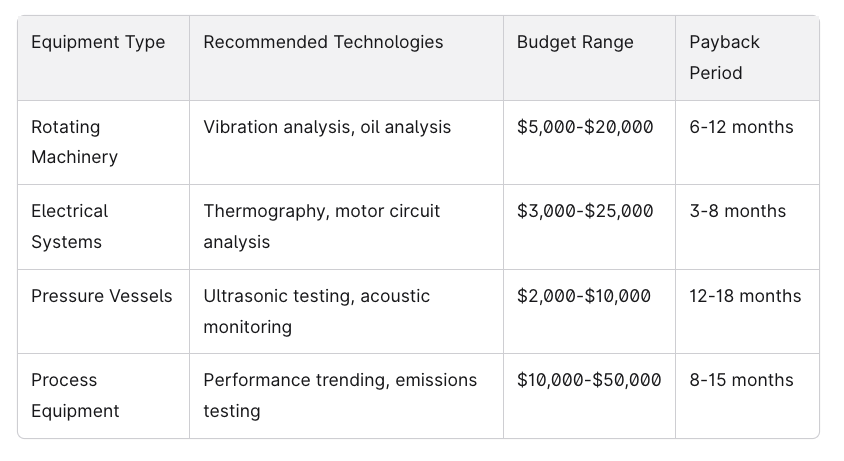
Pilot programs on 5-10 critical assets allow ROI validation before facility-wide implementation, providing data needed to justify expanded predictive maintenance programs. The pilot approach enables organizations to test integration capabilities, validate cost savings projections, and build internal expertise before committing to comprehensive programs.
Successful implementation requires aligning predictive maintenance technology selection with maintenance strategy choices, creating comprehensive programs that address both immediate monitoring needs and long-term maintenance optimization goals. Organizations achieve best results by combining complementary technologies with strategic approaches that match their operational requirements and resource constraints.
Most effective predictive maintenance programs evolve gradually, starting with basic technologies on critical equipment and expanding as experience and budgets allow. This measured approach enables organizations to build predictive maintenance capabilities systematically while demonstrating value at each stage of implementation.
The key to success lies in matching predictive maintenance types to specific operational needs rather than implementing technologies for their own sake. By focusing on equipment where monitoring provides clear benefits and selecting technologies that address actual failure modes, organizations can achieve significant improvements in equipment reliability and maintenance cost optimization.
Organizations implementing comprehensive predictive maintenance programs typically achieve 25-30% reductions in maintenance costs and 40-50% decreases in unplanned downtime, with ROI often exceeding 8:1 within the first year. These results demonstrate the substantial benefits available to organizations that select and implement appropriate types of predictive maintenance for their specific operational requirements.

You might also like
.png)

.png)

MAXIMIZE OEE
Your Tools, Our Technology
Take control of your industrial tools' performance. Our demo will show you how to leverage real-time data, predictive analytics, and comprehensive asset management to minimize downtime and maximize productivity.


“New eyes on your molds production to lead performance towards operational excellence.”

Emanuele Quarin, Digital industrial operations director