November 26, 2025
Mean Time to Repair (MTTR): Comprehensive Guide to Minimizing Downtime and Enhancing System Reliability

In today’s fast-paced business environment, minimizing downtime is crucial for maintaining productivity, ensuring customer satisfaction, and safeguarding revenue. When a system fails, the clock starts ticking—not just against lost time, but also against operational efficiency and business reputation. One of the most critical metrics organizations use to measure their ability to respond to and recover from failures is Mean Time to Repair (MTTR).
This comprehensive guide explores MTTR in detail, explaining its significance, how to calculate it accurately, common challenges, and proven strategies to improve it. Additionally, we’ll highlight why Matix offers the best-in-class solution for optimizing MTTR and maximizing system reliability.
What is Mean Time to Repair (MTTR)?
Mean Time to Repair (MTTR) is a key maintenance metric and performance indicator that measures the average time required to repair a failed system or component and restore it to full operational status. Unlike simple repair time measurements, MTTR encompasses the entire repair process, including failure detection, diagnosis, actual repair work, testing, and final restoration.
MTTR as a Key Performance Indicator
MTTR serves as a vital key performance indicator (KPI) across industries such as manufacturing, IT, telecommunications, healthcare, and utilities. It offers critical insights into maintenance team responsiveness, repair process efficiency, and overall system reliability. Organizations track MTTR to identify bottlenecks, improve resource allocation, and reduce unplanned downtime.
What MTTR Includes and Excludes
Included Phases:
- Detection: Time from when the failure occurs until the first alert is generated.
- Diagnosis: Time spent investigating and identifying the root cause and failed component.
- Repair: Hands-on work to fix or replace the faulty parts.
- Testing: Verification that repairs are effective and the system is recovering.
- Restoration: Final steps to return the system to fully operational status.
Excluded Phases:
- Waiting time for spare parts procurement or delivery.
- Scheduled maintenance activities planned in advance, which can be further optimized through the implementation of a Control Tower solution.
- Administrative or approval delays unrelated to repair work.
Understanding these boundaries ensures accurate MTTR measurement and meaningful comparisons.
Industry Benchmarks for MTTR
MTTR targets vary widely based on asset complexity, criticality, and operational context. Here are typical benchmarks:
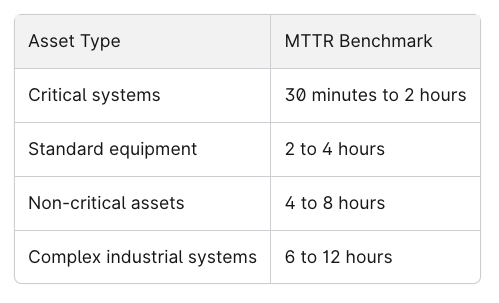
Organizations should set realistic MTTR goals based on their unique operational requirements and continuously strive for improvement.
How to Calculate MTTR: Formula and Practical Examples
Accurate MTTR calculation is essential for tracking performance and making informed maintenance decisions.
The MTTR Formula
The fundamental MTTR formula is:
MTTR = Total Repair Time ÷ Number of Repair Incidents
Where:
- Total Repair Time is the cumulative time spent on all repair activities within a given period.
- Number of Repair Incidents is the total count of repair events during the same period.
Step-by-Step Calculation
- Collect Data: Record the start and end times for each repair incident, including detection, diagnosis, repair, testing, and restoration phases.
- Sum Repair Times: Add the repair durations for all incidents within the time frame.
- Count Repairs: Determine the total number of repair incidents.
- Divide: Calculate the average repair time by dividing total repair time by the number of incidents.
Practical Example
Consider a manufacturing plant with six repair incidents during a month:
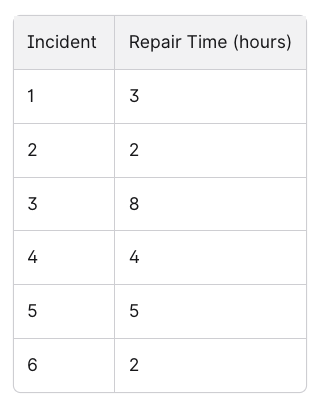
- Total Repair Time = 3 + 2 + 8 + 4 + 5 + 2 = 24 hours
- Number of Incidents = 6
- MTTR = 24 ÷ 6 = 4 hours
This means the average time to repair an incident in this facility is 4 hours.
Advanced Considerations
- Weighted MTTR: Weight repair times based on asset criticality or business impact to prioritize improvements.
- Consistent Time Frames: Calculate MTTR monthly, quarterly, or annually to identify trends and seasonal variations.
- Accurate Data Collection: Use automated monitoring and maintenance management systems to capture precise timestamps and reduce human error.
MTTR in Context: Relationship with Other Reliability Metrics
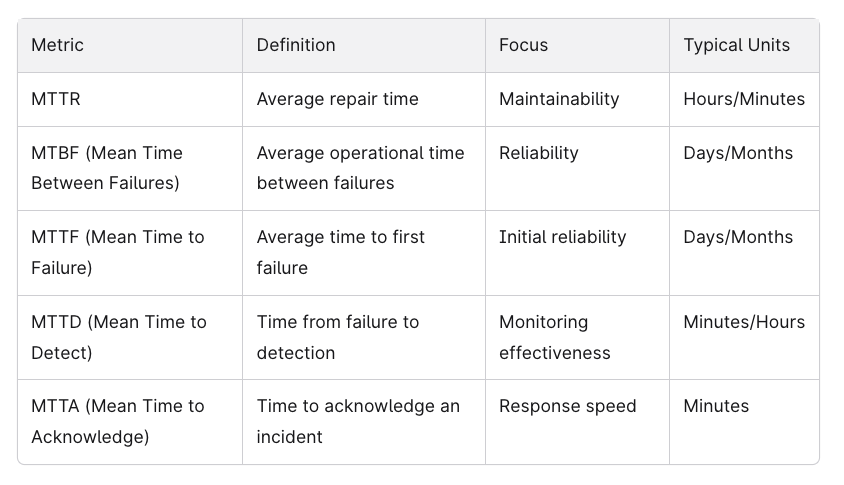
MTTR is one of several essential maintenance and reliability metrics. Understanding its relationship with others helps provide a comprehensive view of system health.
MTTR vs MTBF
MTBF measures how long a system operates before failing, while MTTR measures how long it takes to repair after failure. Together, these metrics provide a full picture of system availability:
Availability = MTBF ÷ (MTBF + MTTR)
Reducing MTTR increases availability, improving uptime and customer satisfaction.
MTTR vs MTTD
MTTD measures how quickly failures are detected, while MTTR measures the time to repair after detection. Faster detection reduces overall downtime by enabling quicker repairs.
Business Impact of MTTR
Reducing MTTR has significant operational and financial benefits:
- Minimized Downtime Costs: Unplanned downtime can cost thousands per minute. Lower MTTR reduces revenue losses.
- Optimized Resource Allocation: Identifies workflow bottlenecks and enables better workforce planning.
- SLA Compliance: Helps meet contractual uptime commitments, avoiding penalties.
- Improved Customer Satisfaction: Faster recovery reduces service disruptions.
- Competitive Advantage: Higher system availability differentiates businesses in reliability-sensitive markets.
- Cost Savings: Reduces overtime, emergency repairs, and expedited shipping expenses.
Common Challenges in Measuring and Improving MTTR
Despite its importance, MTTR measurement and optimization face challenges:
Data Accuracy Issues
- Inconsistent or incomplete time tracking.
- Manual recording errors.
- Varying definitions of repair completion.
Repair Complexity Variations
- Multiple simultaneous failures extend repair times.
- Complex systems require specialized skills.
- Interdependent systems complicate diagnosis.
Parts Availability Delays
- Stock shortages and supply chain disruptions.
- Balancing inventory costs with availability.
Technician Skill Gaps
- Experience level affects repair speed.
- Ongoing training is necessary for complex equipment.
System Interdependencies
- Cascading failures across connected systems.
- Difficulty isolating root causes.
Third-Party Dependencies
- Vendor response times and support quality.
- Contractual obligations and escalation procedures.
Proven Strategies to Improve MTTR
Organizations can implement several strategies to reduce MTTR and improve system reliability:
Preventive and Predictive Maintenance
- Regular inspections and scheduled replacements prevent unexpected failures.
- IoT sensors and condition monitoring detect issues early.
- Data-driven maintenance schedules optimize timing and resource use.
Advanced Monitoring and Intelligent Alerting
- Real-time system health monitoring enables rapid failure detection.
- AI-powered alerts reduce false positives and prevent alert fatigue.
- Centralized dashboards provide visibility and coordination.
Spare Parts Inventory Optimization
- Maintain critical spare parts on-site based on failure history.
- Use digital inventory tracking for accuracy and efficiency.
- Establish vendor partnerships for expedited delivery.
Technology Adoption
- Computerized Maintenance Management Systems (CMMS): Streamline work orders, track repairs, and manage inventory.
- Augmented Reality (AR): Provide technicians with interactive repair guidance.
- Machine Learning: Analyze historical data to predict failures and optimize processes.
- Mobile Applications: Enable technicians to access repair instructions and parts catalogs remotely.
- Integration Platforms: Facilitate data sharing across maintenance, operations, and supply chain teams.
- Cloud-Based Solutions: Offer scalable, collaborative maintenance management.
Training and Knowledge Management
- Continuous technician training to improve skills.
- Document and share best practices and past incident learnings.
- Use root cause analysis to prevent recurrence.
Industry-Specific MTTR Best Practices
Different sectors have unique challenges and MTTR targets:
Manufacturing
- Target MTTR: 2-4 hours for production line equipment.
- Cross-trained technicians and strategic spare parts inventory.
- Predictive maintenance using vibration and thermal monitoring.
Data Centers
- Target MTTR: Under 30 minutes for mission-critical servers.
- Redundant systems and 24/7 staffing.
- Remote diagnostics and vendor support agreements.
Healthcare
- Target MTTR: 1-2 hours for medical devices.
- Specialized biomedical technicians.
- Regulatory compliance and emergency backup procedures.
Utilities
- Target MTTR: 4-8 hours depending on system criticality.
- Emergency response plans and mutual aid networks.
- Smart grid technologies for remote monitoring.
Transportation
- Mobile repair units and parts distribution networks.
- Predictive maintenance via telematics.
- Vendor partnerships for rapid support.
Telecommunications
- Network redundancy and hot-swappable components.
- Remote monitoring for quick detection.
- Distributed spare parts inventory.
Measuring MTTR Success: KPIs and Continuous Improvement
To sustain MTTR improvements, organizations should establish robust measurement frameworks:
- Monthly Trend Analysis: Track MTTR over time to identify patterns.
- Year-Over-Year Comparisons: Measure long-term progress.
- Departmental Benchmarks: Compare teams and locations.
- Leading Indicators: Monitor preventive maintenance completion and spare parts availability.
- Root Cause Tracking: Analyze MTTR by failure type.
- Individual Technician Metrics: Identify training needs and recognize top performers.
- Cost-Benefit Analysis: Calculate ROI of improvement initiatives.
- Regular Review Meetings: Foster cross-functional collaboration and action planning.
Why Matix is the Best Solution for MTTR Optimization
Matix offers a comprehensive, technology-driven platform designed to help organizations reduce MTTR and maximize system reliability.
Key Features of Matix
- Integrated Software: Automates work order management, tracks repair progress, and manages spare parts inventory efficiently.
- Predictive Analytics Powered by Machine Learning: Anticipates failures and optimizes maintenance schedules.
- Augmented Reality Support: Provides technicians with real-time, interactive repair guidance to improve first-time fix rates.
- Advanced Monitoring and Intelligent Alerting: Enables early failure detection, prioritizes critical incidents, and minimizes alert fatigue.
- Mobile Accessibility: Equips maintenance teams with remote access to repair instructions, parts catalogs, and communication tools.
- Data-Driven Insights: Offers detailed dashboards and reports to monitor MTTR trends, identify root causes, and guide continuous improvement.
- Cloud-Based and Scalable: Supports organizations of all sizes across multiple locations with centralized data and consistent processes.
Benefits of Using Matix
- Reduced Repair Times: Streamlined workflows and expert guidance accelerate incident resolution.
- Increased System Availability: Faster repairs minimize unplanned downtime.
- Optimized Resource Allocation: Data insights enable better workforce and inventory management.
- Improved Customer Satisfaction: Reliable systems and quick recovery enhance user experience.
- Cost Savings: Lower emergency repair costs, overtime, and expedited shipping fees.
- Enhanced Compliance: Supports meeting SLAs and regulatory requirements.
Matix’s holistic approach combines cutting-edge technology with user-friendly tools, empowering maintenance teams to achieve operational excellence and competitive advantage.
Conclusion
Mean Time to Repair is more than just a maintenance metric—it’s a strategic indicator of an organization’s operational resilience and efficiency. By accurately measuring MTTR, understanding its relationship with other reliability metrics, and implementing proven improvement strategies, organizations can significantly reduce downtime, control costs, and enhance customer satisfaction.
Embracing advanced technologies and best practices is essential in today’s complex operational environments. Matix stands out as the premier solution for MTTR optimization, offering integrated tools and data-driven insights that empower organizations to maximize uptime and maintain a competitive edge.
Start your journey to MTTR excellence with Matix today—transform your maintenance operations, reduce downtime, and build a foundation for long-term success.

You might also like
.png)

.png)

MAXIMIZE OEE
Your Tools, Our Technology
Take control of your industrial tools' performance. Our demo will show you how to leverage real-time data, predictive analytics, and comprehensive asset management to minimize downtime and maximize productivity.


“New eyes on your molds production to lead performance towards operational excellence.”

Emanuele Quarin, Digital industrial operations director