November 26, 2025
Preventive vs Predictive Maintenance: Complete Guide for 2026
Organizations lose an average of $50,000 per hour due to unplanned equipment downtime, making the choice between preventive vs predictive maintenance one of the most critical decisions for operational success. While both maintenance strategies aim to minimize equipment failures and reduce costs, they take fundamentally different approaches to achieving these goals.
This comprehensive guide explores the key differences between preventive and predictive maintenance, helping you understand when to implement each strategy and how to optimize your maintenance program for maximum efficiency and cost savings.
Key Differences: Preventive vs Predictive Maintenance
The fundamental distinction between preventive and predictive maintenance lies in their triggering mechanisms and data requirements. Understanding these core differences is essential for making informed decisions about your maintenance strategy.
Preventive maintenance follows fixed schedules regardless of equipment condition, performing maintenance tasks at predetermined intervals based on time, usage, or production cycles. This approach relies on historical data, manufacturer recommendations, and industry best practices to establish routine maintenance schedules.
Predictive maintenance uses real-time condition monitoring to trigger maintenance only when needed, leveraging sensor data and analytics to determine the optimal timing for maintenance interventions. This condition-based approach monitors equipment health continuously and schedules maintenance activities based on actual equipment condition rather than arbitrary time intervals.
Cost Comparison:
- Preventive maintenance requires lower upfront investment, typically involving basic maintenance management software and standard tools
- Predictive maintenance reduces long-term operational costs by up to 25% but demands significant initial capital for sensors, analytics platforms, and specialized training
Implementation Complexity:
- Preventive maintenance is simpler to start, requiring basic scheduling systems and maintenance teams familiar with routine procedures
- Predictive maintenance requires sensors and data analysis capabilities, along with skilled personnel who can interpret complex data patterns and make informed maintenance decisions

What is Preventive Maintenance?
Preventive maintenance represents a time-based or usage-based scheduled maintenance strategy designed to prevent equipment failures through regular, planned maintenance activities. This proactive maintenance approach has been the backbone of industrial maintenance programs for decades, providing a structured framework for maintaining asset performance and reliability.
The strategy operates on the principle that regular servicing equipment at predetermined intervals will prevent unexpected breakdowns and extend equipment life. Typical scheduling intervals include:
- Daily: Basic inspections and lubrication tasks
- Weekly: More detailed equipment checks and minor adjustments
- Monthly: Comprehensive inspections and component replacements
- Quarterly: Major system overhauls and detailed analysis
- Annually: Complete equipment refurbishment and safety certifications
Examples of preventive maintenance tasks include quarterly HVAC inspections, monthly oil changes for machinery, annual safety checks for lifting equipment, and weekly cleaning of production line components. These maintenance activities follow established maintenance schedules based on manufacturer recommendations and historical data analysis.
The role of preventive maintenance in reducing emergency repairs cannot be overstated. By addressing potential issues before they escalate into critical failures, organizations can avoid costly repairs and minimize the risk of catastrophic equipment breakdowns that could result in extended machine downtime.
Benefits of Preventive Maintenance
Implementing a comprehensive preventive maintenance program delivers substantial operational and financial benefits that justify the investment in proactive maintenance strategies.
Reduced Unplanned Downtime: Preventive maintenance programs can reduce unplanned downtime by up to 75% compared to reactive maintenance approaches. By performing maintenance at regular intervals, organizations minimize the risk of sudden equipment failures that could halt production or disrupt operations.
Extended Equipment Life: Regular servicing through preventive maintenance work can extend equipment life by 20-40%, significantly improving the return on capital investments. This extension results from addressing wear patterns before they cause irreversible damage to critical components.
Lower Emergency Repair Costs: Preventive maintenance benefits include substantial reductions in emergency repairs, which typically cost 3-5 times more than planned maintenance activities. By preventing major failures, organizations avoid the premium costs associated with urgent parts procurement and overtime labor.
Predictable Maintenance Budgets: The structured nature of preventive maintenance programs enables accurate budget forecasting and resource planning. Organizations can schedule maintenance activities during planned downtime periods, optimizing operational efficiency and minimizing disruption to production schedules.
Improved Workplace Safety: Regular maintenance practices identify potential safety hazards before they cause accidents. This proactive approach to asset health monitoring helps maintain compliance with safety regulations and reduces liability risks.
Limitations of Preventive Maintenance
Despite its widespread adoption, preventive maintenance has several inherent limitations that can impact operational efficiency and maintenance costs.
Potential for Unnecessary Maintenance: Studies indicate that up to 30% of preventive maintenance tasks may be performed on equipment that is still in good working order. This over-maintenance leads to wasted labor and material costs without providing corresponding benefits to equipment reliability.
Fixed Schedules vs Actual Condition: Preventive maintenance schedules may not align with actual equipment condition, resulting in premature component replacement or insufficient maintenance intervals for heavily utilized equipment. This disconnect between scheduled maintenance and actual needs can compromise both efficiency and reliability.
Waste of Parts and Labor: Replacing components based on time rather than condition often results in discarding parts that still have significant useful life remaining. This practice increases material costs and contributes to unnecessary waste in maintenance operations.
Planned Downtime Impact: Scheduled maintenance activities require taking equipment offline during predetermined periods, which may not always align with optimal production schedules. This planned downtime can impact productivity and revenue, particularly in continuous production environments.
Limited Failure Prediction: Preventive maintenance provides limited ability to predict sudden failures between scheduled maintenance intervals. Equipment can still experience unexpected breakdowns due to factors not addressed by routine maintenance schedules.
What is Predictive Maintenance?
Predictive maintenance represents a sophisticated condition-based maintenance approach that leverages real-time monitoring and advanced analytics to optimize maintenance timing and reduce operational costs. This maintenance strategy transforms traditional reactive and preventive approaches by using sensor data and machine learning algorithms to predict when maintenance interventions are actually needed.
The technology foundation of predictive maintenance relies heavily on IoT sensors, machine learning algorithms, and comprehensive data analytics platforms. These technologies work together to continuously monitor equipment health, analyze performance patterns, and generate actionable insights for maintenance teams.
Examples of predictive maintenance applications include vibration analysis for rotating equipment to detect bearing wear before failure, thermal imaging for electrical systems to identify overheating components, and oil analysis to monitor internal engine conditions and predict mechanical problems.
Integration with CMMS and EAM systems enables automated work order generation when sensor data indicates potential equipment issues. This seamless integration ensures that maintenance teams receive timely notifications and can respond proactively to emerging problems.
The real-time condition monitoring approach contrasts sharply with scheduled maintenance methods, providing continuous visibility into equipment performance and enabling just-in-time maintenance interventions that minimize both unnecessary work and unplanned downtime.

Predictive Maintenance Technologies
Several key technologies form the foundation of effective predictive maintenance programs, each designed to monitor specific aspects of equipment health and performance.
Vibration Analysis represents one of the most established predictive maintenance technologies, particularly effective for rotating equipment such as motors, pumps, and compressors. This technique detects bearing wear, misalignment issues, and imbalance problems before they cause significant damage or equipment failure.
Thermal Imaging provides non-invasive monitoring of electrical systems and mechanical components, identifying electrical hotspots, insulation problems, and heat-related issues that could lead to equipment failure. This technology is particularly valuable for preventive detection of electrical faults and overheating conditions.
Oil Analysis offers detailed insights into lubricant condition and internal wear particles, providing early warning signs of mechanical problems. This technology monitors contamination levels, viscosity changes, and wear metal concentrations to assess engine and hydraulic system health.
Motor Circuit Analysis focuses specifically on electrical motor health assessment, detecting issues such as rotor problems, stator winding faults, and bearing defects before they cause motor failure. This specialized technology is essential for maintaining critical motor-driven equipment.
Ultrasonic Testing detects leaks, mechanical issues, and electrical arcing using high-frequency sound analysis. This technology is particularly effective for identifying bearing problems, steam trap failures, and compressed air leaks that impact energy efficiency.
Benefits of Predictive Maintenance
A well-implemented predictive maintenance program delivers significant operational and financial benefits that often exceed the initial investment requirements.
Reduced Maintenance Costs: Predictive maintenance strategies can reduce maintenance costs by 10-40% through optimized timing of maintenance interventions. By performing maintenance only when necessary, organizations eliminate unnecessary work while preventing costly emergency repairs.
Decreased Unplanned Downtime: Organizations implementing predictive maintenance typically experience 35-50% reduction in unplanned downtime through early failure detection. This improvement results from the ability to identify and address problems before they cause equipment failure.
Extended Equipment Life: Predictive maintenance focuses on addressing issues at the optimal time, often extending equipment life beyond what is achievable through preventive maintenance alone. This extension maximizes the return on capital investments and reduces replacement costs.
Optimized Spare Parts Inventory: Predictive maintenance enables more accurate forecasting of parts requirements, reducing both inventory carrying costs and the risk of stockouts. Organizations can maintain lower inventory levels while ensuring critical parts are available when needed.
Enhanced Safety: Continuous condition monitoring provides early warning of potentially dangerous equipment conditions, enabling timely interventions that prevent accidents and maintain workplace safety standards.
Challenges of Predictive Maintenance
Despite its significant benefits, predictive maintenance implementation presents several challenges that organizations must address for successful deployment.
High Initial Investment: Implementing a predictive maintenance program requires substantial upfront investment in sensors, software, and training. The cost of deploying comprehensive monitoring systems can be prohibitive for smaller organizations or low-value assets.
Skilled Technician Requirements: Predictive maintenance challenges include the need for skilled technicians who can interpret complex data patterns and make informed maintenance decisions. This expertise requirement often necessitates significant training investment or hiring specialized personnel.
Complex Data Management: Managing the extensive data generated by condition monitoring systems can overwhelm operators if proper data management tools and processes are not implemented. Organizations must invest in robust analytics platforms and data management capabilities.
Cultural Change Requirements: Successful predictive maintenance implementation requires a cultural shift from reactive to proactive maintenance mindset throughout the organization. This change management process can be time-consuming and requires strong leadership support.
ROI Realization Timeline: While predictive maintenance delivers significant long-term benefits, ROI realization typically takes 12-24 months depending on implementation scope and asset criticality. Organizations must be prepared for this extended payback period.
Cost Analysis: Preventive vs Predictive Maintenance
Understanding the financial implications of preventive vs predictive maintenance is crucial for making informed decisions about maintenance strategy investments. The cost structure and return on investment profiles differ significantly between these approaches.
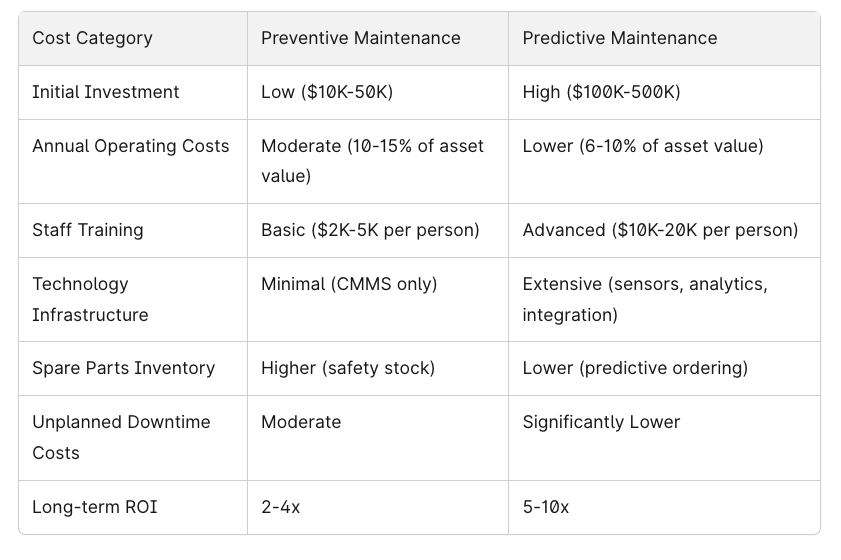
Preventive Maintenance Costs: Lower startup costs make preventive maintenance accessible to organizations with limited capital budgets. Moderate ongoing expenses include scheduled labor, replacement parts, and planned downtime. However, the potential for unnecessary maintenance can inflate long-term costs.
Predictive Maintenance Costs: Higher initial investment requirements reflect the sophisticated technology and expertise needed for implementation. Despite the substantial upfront costs, organizations typically achieve lower long-term operational costs through optimized maintenance timing and reduced emergency repairs.
ROI Calculations: Preventive maintenance typically achieves payback within 6-12 months, while predictive maintenance may require 12-24 months for full ROI realization. However, the long-term financial benefits of predictive maintenance often exceed those of preventive approaches for critical, high-value assets.
When to Choose Preventive vs Predictive Maintenance
Selecting the appropriate maintenance strategy requires careful consideration of multiple factors including asset criticality, failure consequences, organizational readiness, and budget constraints.
Asset Criticality Assessment: High-value equipment that directly impacts production or safety typically benefits more from predictive maintenance approaches. Critical assets with failure costs exceeding $100,000 often justify the investment in sophisticated monitoring systems. Non-critical equipment with lower replacement costs may be better suited for preventive maintenance strategies.
Failure Consequence Analysis: Safety-critical systems require predictive monitoring to prevent catastrophic failures that could result in injury or environmental damage. Equipment failures that could halt entire production lines warrant predictive maintenance investment, while systems with minimal failure impact can rely on preventive approaches.
Technology Readiness: Organizations with basic CMMS capabilities and limited technical expertise should start with preventive maintenance before advancing to predictive strategies. Companies with strong data analytics capabilities and technical staff can implement predictive maintenance more effectively.
Budget Considerations: Budget-constrained environments may need to prioritize preventive maintenance for most assets while implementing predictive maintenance only for the most critical equipment. Organizations with adequate capital budgets can take a more comprehensive approach to predictive maintenance deployment.
Industry Examples: Manufacturing facilities with continuous production processes typically benefit from predictive maintenance on critical production equipment. Small businesses with limited technical resources often find preventive maintenance more practical and cost-effective for their operational needs.
Hybrid Maintenance Strategies
The most effective maintenance programs often combine preventive and predictive approaches to optimize maintenance efficiency and cost-effectiveness across diverse asset portfolios.
Foundation with Overlay: Using preventive maintenance as a foundation with predictive overlay for critical assets provides comprehensive coverage while managing implementation complexity. This approach allows organizations to maintain basic maintenance standards while investing in advanced monitoring for high-value equipment.
Risk-Based Maintenance: A risk-based maintenance approach balances cost and reliability considerations by applying different maintenance strategies based on equipment criticality and failure consequences. This methodology ensures that maintenance resources are allocated efficiently across the entire asset portfolio.
Implementation Roadmap: Organizations typically follow a progression from reactive to preventive to predictive maintenance as they mature their maintenance capabilities. This evolutionary approach allows for gradual skill development and technology adoption while maintaining operational stability.
The hybrid approach recognizes that different assets require different maintenance strategies based on their characteristics, criticality, and operational context. By combining preventive and predictive maintenance techniques, organizations can optimize asset performance while managing implementation costs and complexity.
Implementation Guide: Getting Started
Successfully implementing either preventive or predictive maintenance requires careful planning, appropriate technology selection, and comprehensive change management to ensure program success.
Step-by-Step Implementation Process:
- Asset Assessment: Conduct a comprehensive inventory of all equipment, categorizing assets by criticality, value, and failure consequences
- Current State Analysis: Evaluate existing maintenance practices, costs, and performance metrics to establish baseline measurements
- Strategy Selection: Choose appropriate maintenance strategies for different asset categories based on criticality and cost-benefit analysis
- Technology Requirements: Select and implement necessary technology platforms, including CMMS for preventive maintenance or sensors and analytics for predictive approaches
- Staff Training: Provide comprehensive training for maintenance teams on new procedures, technologies, and data interpretation techniques
- Pilot Implementation: Start with a limited scope pilot program to test procedures and refine processes before full deployment
- Performance Monitoring: Establish key performance indicators and monitoring systems to track program effectiveness and identify improvement opportunities
Technology Requirements: Preventive maintenance implementations require robust CMMS platforms that can manage work orders, scheduling, and inventory. Predictive maintenance programs need sophisticated sensor networks, data analytics platforms, and integration capabilities to process and analyze condition monitoring data effectively.
Staff Training Needs: Preventive maintenance requires training on scheduling procedures, work order management, and basic troubleshooting techniques. Predictive maintenance demands advanced training in data interpretation, condition monitoring technologies, and analytical decision-making processes.
Success Metrics: Key performance indicators include equipment uptime, maintenance costs per asset, mean time between failures, and overall equipment effectiveness (OEE). These metrics provide objective measures of program success and identify areas for continuous improvement.
Common Implementation Mistakes: Frequent pitfalls include inadequate training, poor data quality, lack of management support, and attempting to implement too many changes simultaneously. Organizations should focus on gradual implementation with strong change management support.

Industry Applications and Case Studies
Real-world implementations demonstrate the practical benefits and challenges of different maintenance strategies across various industries.
Manufacturing Sector: A leading automotive manufacturer implemented predictive maintenance on critical production equipment, reducing unplanned downtime from 800 to 200 hours annually. The program utilized vibration analysis and thermal imaging to monitor 500+ assets, achieving a 60% reduction in emergency repairs and $2.3 million in annual cost savings.
Healthcare Industry: A major hospital network implemented preventive maintenance programs for medical equipment to ensure regulatory compliance and patient safety. The systematic approach to routine maintenance activities reduced equipment failures by 45% and maintained 99.7% availability for critical life-support systems.
Energy Sector: A power generation company deployed predictive monitoring to prevent catastrophic turbine failures, avoiding potential losses exceeding $50 million. The predictive maintenance program used advanced sensor data and machine learning to predict bearing failures 8-12 weeks before occurrence, enabling planned maintenance during scheduled outages.
Transportation Fleet: A logistics company implemented a hybrid approach combining preventive maintenance for routine services with predictive monitoring for engine health. This strategy optimized fleet maintenance schedules, reduced vehicle downtime by 35%, and extended average vehicle service life by 18 months.
ROI Examples: Manufacturing implementations typically achieve 4-8x ROI within 24 months, while utility applications can deliver 10-15x returns due to the high cost of unplanned outages. Healthcare applications focus more on compliance and safety benefits, with ROI measured in risk reduction rather than pure cost savings.
These case studies demonstrate that maintenance strategy selection and implementation success depend heavily on industry context, asset characteristics, and organizational capabilities.
Future of Maintenance: Emerging Trends
The maintenance landscape continues evolving rapidly with emerging technologies that enhance both preventive and predictive maintenance capabilities.
AI and Machine Learning Enhancement: Advanced algorithms are improving predictive maintenance accuracy by analyzing complex patterns in sensor data that human operators might miss. Machine learning systems continuously improve their predictive capabilities as they process more operational data, leading to increasingly precise failure predictions.
Digital Twins for Virtual Maintenance: Digital twin technology enables virtual maintenance planning and testing, allowing organizations to simulate maintenance scenarios and optimize procedures before performing actual work. This approach reduces maintenance risks and improves efficiency by validating maintenance strategies in virtual environments.
Edge Computing for Real-Time Decisions: Edge computing capabilities enable real-time decision making by processing sensor data locally rather than sending it to centralized systems. This advancement reduces latency and enables immediate responses to critical equipment conditions.
ERP Integration for Comprehensive Management: Integration with ERP systems provides comprehensive asset management capabilities, linking maintenance activities with financial planning, inventory management, and operational scheduling. This holistic approach optimizes resource allocation and supports strategic decision-making.
Augmented Reality for Remote Support: AR technology enables remote maintenance support and training, allowing expert technicians to guide on-site personnel through complex procedures. This capability is particularly valuable for organizations with distributed assets or limited local expertise.
These emerging trends indicate that the future of maintenance will be increasingly data-driven, automated, and integrated with broader business systems. Organizations that adopt these technologies proactively will gain significant competitive advantages through improved reliability, reduced costs, and enhanced operational efficiency.
The convergence of AI, IoT, and advanced analytics is creating new possibilities for maintenance optimization that were unimaginable just a few years ago. As these technologies mature and become more accessible, they will reshape how organizations approach asset management and maintenance planning.
Successful organizations will need to balance innovation with practical implementation, ensuring that new technologies deliver measurable value while maintaining operational stability. The key to success lies in developing comprehensive maintenance strategies that leverage the best aspects of both traditional and emerging approaches.
By understanding the strengths and limitations of preventive vs predictive maintenance, organizations can make informed decisions that optimize their maintenance programs for maximum effectiveness and return on investment. The future belongs to those who can skillfully combine proven maintenance practices with innovative technologies to achieve unprecedented levels of reliability and efficiency.

You might also like
.png)

.png)

MAXIMIZE OEE
Your Tools, Our Technology
Take control of your industrial tools' performance. Our demo will show you how to leverage real-time data, predictive analytics, and comprehensive asset management to minimize downtime and maximize productivity.


“New eyes on your molds production to lead performance towards operational excellence.”

Emanuele Quarin, Digital industrial operations director