November 26, 2025
Enterprise Asset Management: A Complete Guide to Optimizing Physical Assets

Industrial equipment failures cost organizations billions annually in unplanned downtime and emergency repairs. For asset intensive industries like manufacturing, utilities, and transportation, the challenge extends far beyond fixing broken equipment - it involves strategically managing physical assets throughout their entire lifecycle to maximize value, minimize risk, and ensure operational excellence.
Enterprise asset management (EAM) represents a comprehensive approach to managing an organization’s physical assets from acquisition to disposal. Unlike traditional maintenance strategies that focus primarily on repairs and replacements, enterprise asset management eam integrates strategic asset planning, performance optimization, and lifecycle management to transform how organizations manage assets and drive operational efficiency.
This guide explores how EAM systems work, their core benefits over traditional maintenance approaches, essential capabilities, and best practices for successful implementation across various industries.

What is Enterprise Asset Management (EAM)
Enterprise asset management is a comprehensive set of processes, systems, and software solutions designed to strategically manage an organization’s physical assets across their complete asset’s lifecycle. This includes planning, acquisition, deployment, operation, maintenance, and eventual disposal of enterprise assets ranging from production machinery and facility infrastructure to fleet assets and critical equipment.
The distinction from traditional maintenance approaches is fundamental. While conventional maintenance management focuses primarily on reactive repairs and scheduled servicing, enterprise asset management encompasses strategic asset planning, performance optimization, risk management, and integration with broader business processes. EAM systems enable organizations to make data-driven decisions about asset strategies, capital investments, and operational priorities.
Core Components of Enterprise Asset Management
Modern EAM solutions integrate several critical components that work together to optimize asset performance:
Asset Tracking and Registry: Centralized databases store comprehensive asset information including specifications, maintenance history, warranty details, performance metrics, and documentation. This foundation enables effective asset data management and informed decision-making.
Maintenance Scheduling and Management: Automated workflows for preventive maintenance, predictive maintenance, and corrective maintenance ensure optimal asset health while minimizing maintenance costs and operational disruptions.
Supply Chain Integration: Connection with procurement processes, inventory management, and vendor relationships ensures necessary parts, materials, and services are available when needed while optimizing inventory levels.
Compliance Management: Built-in frameworks for adhering to environmental, health, safety, and industry-specific regulations throughout asset lifecycles, supporting regulatory compliance and risk management.
Performance Analytics: Advanced analytics and business intelligence capabilities track key performance indicators, identify trends, and provide insights for optimizing asset utilization and extending asset lifecycles.
Role in Asset-Intensive Industries
Enterprise asset management plays a crucial role across multiple industries where physical assets represent significant capital investments and operational dependencies. Manufacturing organizations rely on EAM to optimize production equipment uptime and efficiency. Utilities manage complex infrastructure including power generation equipment, transmission lines, and distribution networks. Healthcare organizations track medical devices and facility systems to ensure patient safety and regulatory compliance.
Transportation companies utilize EAM for fleet management, optimizing vehicle deployment, maintenance schedules, and fuel management. Oil and gas operations depend on EAM to manage pipeline integrity, offshore platforms, and refinery equipment where asset failures can have catastrophic consequences.
Integration with Business Processes
Effective enterprise asset management extends beyond maintenance and operations teams to integrate with broader business functions including finance, procurement, human resources, and strategic planning. This integration enables organizations to align asset strategies with business objectives, optimize capital allocation, and improve overall operational performance.
Financial integration provides visibility into total cost of ownership, enabling accurate cost tracking and budgeting for asset-related expenses. Procurement integration streamlines purchasing processes and vendor management. Human resources integration ensures proper training and certification for maintenance teams working with critical assets.
How Enterprise Asset Management Systems Work
Modern EAM systems leverage cloud-based architecture that has largely replaced legacy on-premises solutions. This technological foundation provides improved scalability, accessibility, and reduced IT overhead while supporting real time data analysis and mobile workforce requirements.
The shift to cloud software enables organizations to access EAM functionality without significant upfront infrastructure investments, while providing automatic updates, enhanced security, and seamless integration capabilities with other business applications.
Real-Time Data Collection and Integration
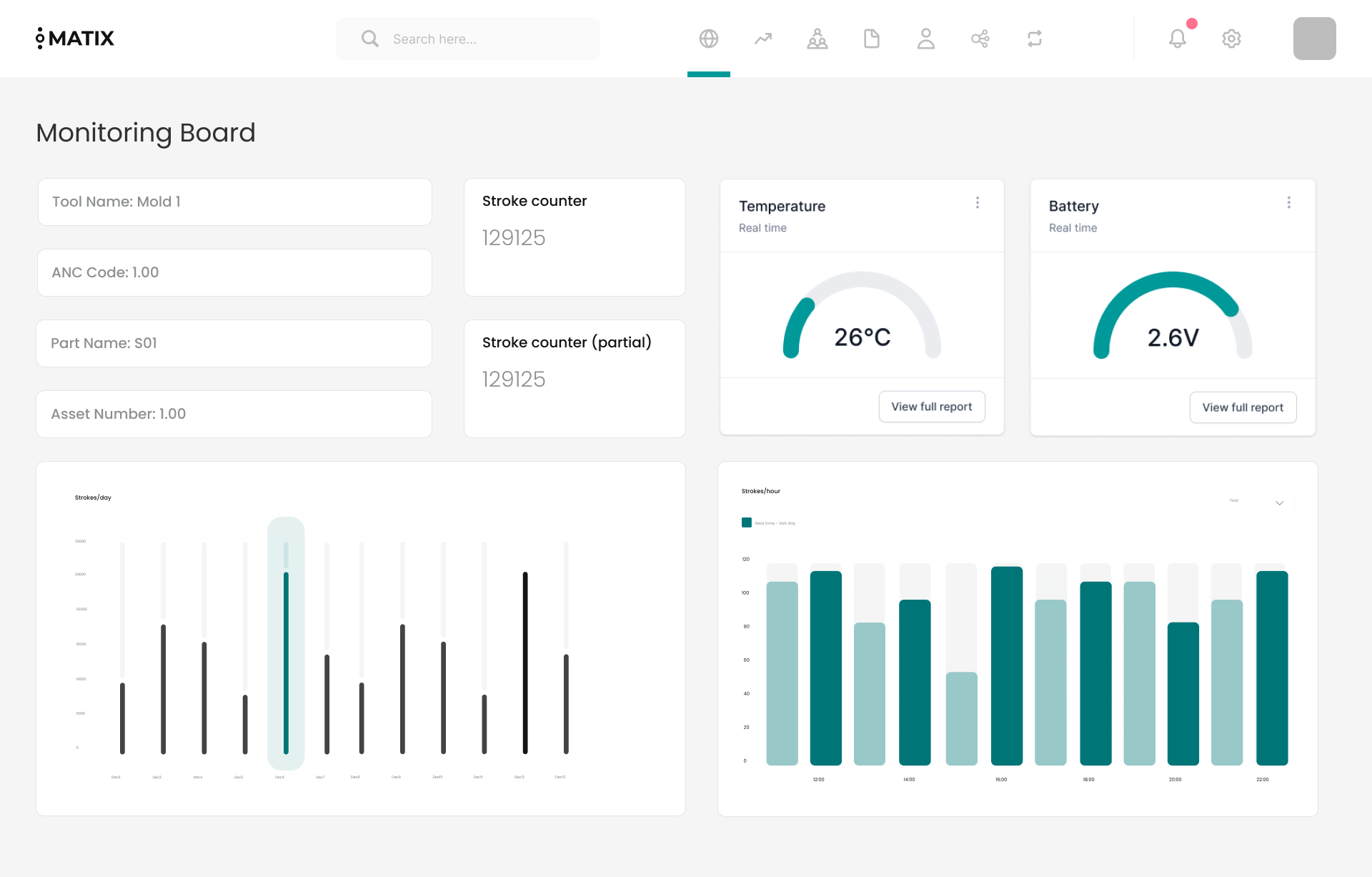
Contemporary EAM systems collect real-time operational data through various technologies including IoT sensors, RFID tags, GPS tracking, and barcode scanning. These sensors monitor asset health, performance metrics, operational conditions, and usage patterns to provide comprehensive visibility into asset status and performance.
Integration with existing enterprise systems represents a critical capability. EAM platforms connect with ERP systems for financial data, supply chain management systems for inventory and procurement, and business intelligence platforms for advanced analytics. This integration ensures data consistency across business functions and enables comprehensive reporting and analysis.
Centralized Asset Databases and Data Management
The foundation of effective enterprise asset management lies in comprehensive data management. Centralized asset databases store detailed records for each enterprise asset, including technical specifications, maintenance schedules, performance history, warranty information, and operational documentation.
Asset information encompasses both structured data like maintenance records and costs, and unstructured data including technical manuals, safety procedures, and inspection reports. Modern EAM systems provide document management capabilities that link this information directly to specific assets, ensuring maintenance teams have immediate access to relevant information.
Automated Workflows and Mobile Applications
EAM systems automate complex business processes including work order generation, approval workflows, resource allocation, and maintenance scheduling. These automated workflows reduce administrative overhead, improve consistency, and ensure proper procedures are followed for maintenance activities.
Mobile applications have become essential for field operations, enabling maintenance teams to access asset information, update maintenance records, and complete work orders regardless of location. These applications often support offline functionality, ensuring productivity even in remote locations where connectivity may be limited.
Advanced mobile capabilities include barcode scanning for asset identification, photo capture for documentation, GPS tracking for location verification, and integration with specialized tools like vibration analyzers and thermal imaging cameras.
Core Benefits of EAM Systems
Organizations implementing comprehensive enterprise asset management solutions typically experience significant improvements across multiple operational dimensions. These benefits extend beyond maintenance efficiency to impact overall business performance, regulatory compliance, and strategic asset planning.
Prevent Unplanned Downtime
One of the most significant benefits of EAM implementation is the dramatic reduction in unplanned downtime. Organizations frequently achieve downtime reductions of up to 50% through predictive maintenance capabilities that identify potential failures before they occur.
Real-time asset health monitoring detects early signs of wear, performance degradation, or anomalous conditions that could lead to equipment failures. This early warning capability enables maintenance teams to schedule preventive maintenance during planned downtime windows rather than responding to emergency failures.
The impact extends beyond individual equipment to entire production lines and business operations. In manufacturing environments, preventing a single critical equipment failure can avoid cascading disruptions that affect multiple production stages and customer deliveries.

Reduce Maintenance Costs and Extend Asset Lifecycles
Effective maintenance management through EAM systems typically reduces overall maintenance costs by 15-25% while simultaneously extending equipment lifecycles. This optimization occurs through several mechanisms including improved maintenance scheduling, better inventory management, and more effective resource allocation.
Predictive maintenance strategies enabled by EAM systems allow organizations to transition from time-based maintenance schedules to condition-based approaches. This shift eliminates unnecessary maintenance activities while ensuring interventions occur at optimal times based on actual asset condition rather than arbitrary schedules.
Extended asset lifecycles result from proactive maintenance approaches that address minor issues before they cause major damage. Regular monitoring and trending analysis enable maintenance teams to identify gradual degradation patterns and implement corrective actions that preserve asset integrity and performance.
Improve Regulatory Compliance and Safety
Enterprise asset management systems provide comprehensive audit trails and documentation required for regulatory compliance across various industries. Automated record-keeping ensures maintenance activities are properly documented, inspection schedules are maintained, and compliance reports can be generated efficiently.
Safety improvements result from better equipment monitoring, proper maintenance procedures, and comprehensive risk assessment capabilities. EAM systems help identify potentially hazardous conditions before they pose risks to personnel or operations.
Enhance Operational Efficiency and Asset Utilization
Improved operational efficiency emerges from optimized maintenance planning, better resource allocation, and increased asset availability. EAM systems provide visibility into asset utilization patterns, enabling organizations to optimize deployment and identify underutilized resources.
Performance benchmarks and analytics capabilities enable continuous improvement in operational performance. Organizations can identify best practices, compare performance across different locations or asset types, and implement standardized procedures that drive efficiency improvements.
Enhanced asset utilization directly impacts return on investment for expensive physical assets. By maximizing productive time and optimizing deployment, organizations extract greater value from their asset investments while deferring new capital expenditures.
EAM vs CMMS: Understanding the Key Differences
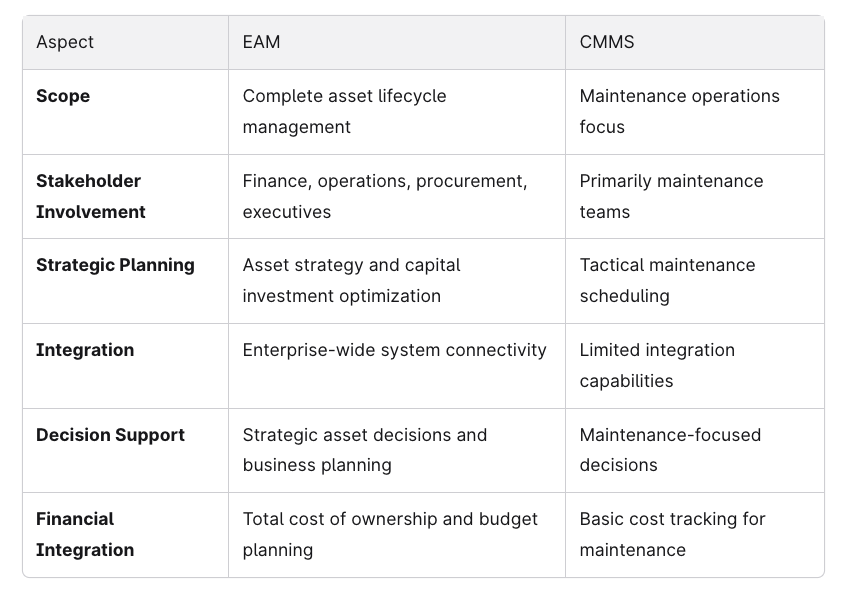
While computerized maintenance management systems (CMMS) and enterprise asset management platforms share some common functionality, their scope, stakeholder involvement, and strategic impact differ. Understanding these differences is crucial for organizations evaluating asset management solutions.
Scope and Functional Differences
Computerized maintenance management systems traditionally focus on work order management, preventive maintenance scheduling, and basic inventory tracking for maintenance operations. While these capabilities are essential, they represent only a subset of comprehensive asset lifecycle management.
Enterprise asset management encompasses strategic asset planning, acquisition processes, deployment optimization, performance management, and disposal strategies. EAM systems integrate with procurement processes for capital planning, financial systems for total cost of ownership analysis, and operations systems for performance optimization.
Stakeholder and Decision-Making Scope
CMMS deployment typically involves maintenance and operations teams with limited visibility to other business functions. Maintenance managers use these systems to schedule work, track completion, and manage spare parts inventory.
EAM implementation requires involvement from finance, procurement, operations, and executive stakeholders because asset decisions impact capital allocation, operational strategy, and business performance. This broader stakeholder involvement enables enterprise-wide asset strategies that align with business objectives.
Strategic vs Tactical Focus
The distinction between strategic and tactical focus represents perhaps the most significant difference between EAM and CMMS approaches. Computerized maintenance management systems excel at tactical maintenance execution ensuring work orders are completed efficiently and preventive maintenance schedules are maintained.
Enterprise asset management platforms support strategic decisions about asset portfolios, capital investment priorities, technology refresh cycles, and operational optimization. These strategic capabilities enable organizations to maximize long-term asset value rather than simply maintaining current equipment.
Essential EAM Capabilities and Features
Modern enterprise asset management solutions like Matix incorporate advanced capabilities that transform asset management from reactive maintenance to strategic asset optimization. These capabilities leverage cutting-edge technologies including artificial intelligence, machine learning, and IoT integration to deliver unprecedented visibility and control over physical assets.
Predictive Maintenance and Analytics
Advanced analytics represent the cornerstone of modern EAM systems, enabling organizations to transition from reactive maintenance to predictive approaches that optimize maintenance timing and resource allocation.
AI and Machine Learning Integration: Predictive maintenance leverages machine learning algorithms to analyze historical maintenance data, operational parameters, and real-time sensor data to forecast potential failures. These algorithms continuously learn from new data, improving accuracy over time and identifying patterns that human analysis might miss.
Condition-Based Monitoring: Integration with condition monitoring technologies including vibration analysis, thermal imaging, oil analysis, and ultrasonic monitoring provides real-time insights into asset health. These technologies detect early indicators of potential failures, enabling proactive interventions.
Performance Trending and Benchmarking: EAM systems track asset performance against historical baselines and industry benchmarks, identifying gradual degradation patterns that could indicate developing problems. This trending analysis enables maintenance teams to optimize performance before issues impact operations.
Manufacturing organizations implementing predictive maintenance through EAM systems frequently achieve maintenance cost reductions of 20-30% while improving asset reliability and extending equipment lifecycles. Root cause analysis capabilities help identify recurring failure patterns and implement permanent corrective actions.
Workflow and Maintenance Management
Comprehensive workflow management capabilities streamline maintenance operations while ensuring consistency and quality across all maintenance activities.
Automated Work Order Generation: EAM systems automatically generate work orders based on time intervals, usage metrics, or condition triggers from monitoring systems. This automation ensures maintenance activities are never missed while optimizing scheduling based on asset priorities and resource availability.
Resource Scheduling and Allocation: Advanced scheduling capabilities consider technician skills, tool availability, parts inventory, and asset criticality to optimize maintenance schedules. Gantt chart visualization and critical path analysis help maintenance teams identify scheduling conflicts and optimize resource utilization.
Quality Assurance and Inspection Management: Built-in inspection checklists, quality assurance workflows, and digital documentation capabilities ensure maintenance work meets required standards. Digital forms and mobile applications streamline data collection and improve record accuracy.
Performance Reporting and KPIs: Comprehensive reporting capabilities track key performance indicators including Mean Time Between Failures (MTBF), Mean Time to Repair (MTTR), Overall Equipment Effectiveness (OEE), and asset availability. These metrics enable continuous improvement and demonstrate maintenance effectiveness.
Integration and Mobility
Modern EAM systems excel at integration with existing enterprise systems and providing mobile access for field operations.
API Connectivity: Robust API frameworks enable integration with ERP systems, supply chain management platforms, financial systems, and specialized industrial applications. This connectivity ensures data consistency across business applications and eliminates duplicate data entry.
Mobile Applications and Offline Capability: Field-optimized mobile applications provide access to asset information, work order management, and documentation capabilities regardless of location. Offline synchronization ensures productivity continues even when connectivity is unavailable.
Document Management: Integrated document management capabilities store technical manuals, safety procedures, compliance documentation, and maintenance history directly linked to specific assets. This centralized documentation improves maintenance efficiency and ensures critical information is readily available.
GIS Integration: For organizations managing linear assets like pipelines, transmission lines, or transportation infrastructure, GIS data integration provides spatial visualization and location-based asset management capabilities.
Industry Applications of Enterprise Asset Management
Enterprise asset management solutions have evolved to address the specific requirements and challenges of various industries, each with unique asset types, regulatory requirements, and operational priorities.
Manufacturing and Production
Manufacturing organizations utilize EAM systems to optimize production equipment across automotive, aerospace, consumer goods, and industrial manufacturing sectors. Asset management practices focus on maximizing equipment uptime, optimizing production efficiency, and managing complex supply chains for spare parts and consumables.
Critical manufacturing applications include managing industrial machinery, production lines, quality control equipment, and facility infrastructure. Predictive maintenance capabilities are particularly valuable in manufacturing environments where unplanned downtime can cascade through entire production systems, impacting customer deliveries and revenue.
Advanced manufacturing organizations leverage EAM integration with manufacturing execution systems (MES) and quality management systems to optimize overall equipment effectiveness and maintain consistent product quality.
Oil & Gas Operations
The oil and gas industry relies heavily on EAM systems for managing complex, geographically distributed assets including drilling equipment, refineries, pipelines, and offshore platforms. Asset failures in this industry can have catastrophic safety, environmental, and financial consequences, making robust asset management essential.
Pipeline integrity management represents a critical application, where EAM systems track inspection schedules, manage compliance documentation, and coordinate maintenance activities across thousands of miles of infrastructure. Integration with SCADA systems provides real-time monitoring of pipeline conditions and automated alerting for potential issues.
Offshore platform management requires specialized EAM capabilities for managing assets in remote, harsh environments where maintenance logistics are complex and costly. Predictive maintenance becomes crucial for minimizing unplanned maintenance trips to offshore facilities.
Utilities and Energy
Electric, gas, and water utilities manage vast infrastructure networks that require sophisticated asset management approaches. Power generation equipment, transmission lines, distribution networks, and customer service infrastructure represent billions of dollars in capital investment that must be optimized for reliability and efficiency.
Public asset management in utilities involves regulatory compliance for infrastructure reliability, environmental impact, and customer service standards. EAM systems help utilities demonstrate compliance with regulatory requirements while optimizing maintenance costs and infrastructure reliability.
Smart grid integration enables utilities to leverage real-time data from smart meters and grid sensors to optimize asset deployment and identify potential infrastructure problems before they impact customers.
Transportation and Fleet Management
Transportation organizations including railways, airlines, shipping companies, and public transit systems rely on EAM for managing complex fleets of mobile assets. Fleet assets require specialized management approaches that consider utilization patterns, regulatory requirements, and operational schedules.
Railway applications include locomotive and rolling stock management, track infrastructure maintenance, and signal system optimization. Airlines utilize EAM for aircraft maintenance scheduling, parts inventory management, and regulatory compliance with aviation authorities.
Public transit agencies leverage EAM systems to optimize bus and rail fleet deployment, schedule preventive maintenance around service requirements, and manage facility infrastructure including stations, maintenance yards, and support systems.
Healthcare Organizations
Healthcare organizations face unique asset management challenges including medical device lifecycle management, regulatory compliance with FDA and other health authorities, and optimization of expensive diagnostic and treatment equipment.
Medical device management requires tracking calibration schedules, maintenance history, utilization patterns, and regulatory compliance documentation. EAM systems help healthcare organizations optimize equipment deployment, reduce maintenance costs, and ensure patient safety through proper equipment maintenance.
Facility management applications include HVAC systems, emergency power systems, water treatment, and other critical infrastructure that supports patient care. Hospital asset management must balance operational efficiency with patient safety and regulatory compliance requirements.
Mining and Heavy Industry
Mining operations require specialized EAM capabilities for managing heavy equipment in remote, harsh environments where equipment failures can impact safety and production. Industrial assets in mining include excavators, haul trucks, processing equipment, and infrastructure systems.
Remote location challenges require EAM systems that support offline operations, satellite communications, and specialized logistics for parts and maintenance supplies. Predictive maintenance becomes crucial for minimizing equipment downtime in locations where replacement equipment or specialized technicians may not be readily available.
Safety and environmental compliance are critical considerations in mining applications, where equipment failures can impact worker safety and environmental protection. EAM systems help mining organizations maintain compliance documentation and implement proactive safety measures.
Implementation Best Practices for EAM Success
Successful enterprise asset management implementation requires careful planning, strong change management, and a phased approach that minimizes operational disruption while maximizing benefits. Organizations that follow proven best practices significantly improve their chances of achieving expected returns on EAM investments.
Asset Data Cleanup and Standardization
The foundation of effective EAM implementation begins with comprehensive asset data cleanup and standardization before system deployment. Many organizations underestimate this critical phase, leading to ongoing data quality issues that compromise system effectiveness.
Asset data standardization involves establishing consistent naming conventions, classification schemas, and data structures across all asset types and locations. This standardization enables effective reporting, analysis, and benchmarking across the organization while supporting integration with other business systems.
Data governance frameworks establish clear ownership and accountability for asset information, ensuring ongoing data quality and consistency. These frameworks define roles and responsibilities for data entry, validation, and maintenance while establishing procedures for handling data discrepancies and updates.
Change Management and Stakeholder Engagement
EAM implementation represents a significant organizational change that impacts multiple departments and business processes. Successful implementations require comprehensive change management strategies that address technical, process, and cultural challenges.
Stakeholder engagement begins early in the planning process and continues throughout implementation. Key stakeholders include maintenance and operations teams, finance, procurement, IT, and executive leadership. Each stakeholder group has different priorities and concerns that must be addressed through targeted communication and training programs.
Training programs must address both technical system usage and new business processes enabled by EAM capabilities. Maintenance teams require training on mobile applications and new workflow processes. Finance teams need training on asset cost tracking and reporting capabilities. Procurement teams must understand integration with purchasing workflows and vendor management.
Phased Rollout and Risk Management
Phased implementation approaches reduce risk and enable organizations to learn from early deployments before expanding to additional locations or asset types. Initial phases typically focus on critical assets or high-impact areas where benefits can be demonstrated quickly.
Pilot implementations provide valuable lessons about system configuration, user adoption, and integration challenges that inform subsequent phases. These pilots also generate early wins that build organizational confidence and support for broader deployment.
Risk management throughout implementation includes contingency planning for system issues, data migration challenges, and user adoption problems. Backup procedures ensure operational continuity during system transitions while providing fallback options if unexpected issues arise.
Performance Measurement and Continuous Improvement
Establishing baseline metrics before EAM implementation enables organizations to measure improvement and demonstrate return on investment. Key performance indicators should align with organizational objectives and cover operational efficiency, cost reduction, and asset reliability improvements.
Regular performance reviews assess progress against implementation objectives and identify opportunities for optimization. These reviews should involve key stakeholders and focus on both quantitative metrics and qualitative feedback about system effectiveness and user experience.
Continuous improvement processes leverage EAM capabilities to identify optimization opportunities and implement best practices across the organization. Advanced analytics capabilities help identify patterns and trends that drive ongoing improvements in maintenance strategies and operational efficiency.
Vendor Evaluation and Partnership
Selecting the right EAM software requires careful evaluation of functionality, industry expertise, implementation support, and long-term partnership potential. Vendor evaluation should consider not only current requirements but also future needs as the organization’s asset management maturity evolves.
Industry expertise becomes particularly important for organizations in specialized sectors with unique regulatory requirements or operational challenges. Vendors with deep industry knowledge can provide valuable insights about best practices and help avoid common implementation pitfalls.
Long-term partnership considerations include vendor financial stability, product development roadmap, and ongoing support capabilities. EAM implementations represent significant long-term commitments, making vendor partnership quality crucial for ongoing success.
The Future of Enterprise Asset Management
The enterprise asset management landscape continues evolving rapidly, driven by emerging technologies, changing business requirements, and increasing focus on sustainability and operational efficiency. Organizations planning EAM investments must consider these trends to ensure their solutions remain relevant and effective over time.
Digital Twin Technology and Advanced Simulation
Digital twin technology represents one of the most promising developments in asset management, creating virtual replicas of physical assets that enable advanced simulation, analysis, and optimization. These digital representations integrate real-time sensor data with engineering models to provide unprecedented insights into asset performance and condition.
Digital twins enable organizations to simulate different operating scenarios, test maintenance strategies, and optimize asset deployment without impacting actual operations. Predictive models can simulate the impact of different maintenance approaches, helping organizations optimize maintenance timing and resource allocation.
Manufacturing organizations are beginning to implement digital twins for complex production equipment, enabling real-time optimization of operating parameters and predictive maintenance strategies. As computing costs decrease and modeling capabilities improve, digital twin adoption will expand across various industries and asset types.
Augmented Reality and Remote Assistance
Augmented reality applications are transforming maintenance training and field service operations by overlaying digital information onto physical assets. Maintenance technicians can access technical documentation, step-by-step procedures, and real-time guidance through AR interfaces while working on equipment.
Remote assistance capabilities enable expert technicians to provide guidance to field personnel regardless of location. This capability is particularly valuable for organizations with geographically distributed assets or specialized equipment that requires expert knowledge for maintenance and troubleshooting.
Training applications use augmented reality to provide immersive learning experiences that improve retention and reduce training time. New technicians can practice procedures on virtual equipment before working on actual assets, reducing training costs and improving safety.
Edge Computing and Real-Time Analytics
Edge computing capabilities enable real-time processing of sensor data at asset locations, reducing latency and bandwidth requirements while improving response times for critical alerts. This distributed processing approach becomes essential as organizations deploy increasing numbers of IoT sensors and require immediate response to critical conditions.
Real-time analytics at the edge enable immediate response to safety hazards, equipment failures, or operational anomalies without requiring communication with centralized systems. This capability is particularly valuable for remote assets or critical safety systems where communication delays could have serious consequences.
Advanced edge analytics will enable more sophisticated predictive maintenance algorithms that operate independently of network connectivity while providing immediate alerts and recommendations to maintenance teams.
Sustainability Integration and Environmental Impact
Environmental sustainability considerations are becoming integral to asset management strategies as organizations face increasing pressure to demonstrate environmental responsibility and comply with sustainability regulations. EAM systems will increasingly incorporate carbon footprint tracking, energy efficiency monitoring, and environmental impact assessment capabilities.
Circular economy principles will influence asset lifecycle strategies, emphasizing reuse, refurbishment, and recycling over disposal. EAM systems will need to support these strategies through enhanced tracking of material flows, component reuse, and end-of-life processing.
Sustainability reporting requirements will drive demand for comprehensive environmental impact tracking throughout asset lifecycles. Organizations will need to demonstrate not only financial return on assets but also environmental stewardship and social responsibility.
Cloud-Native Solutions and SaaS Adoption
The transition to cloud-native EAM solutions will accelerate as organizations recognize the benefits of reduced IT overhead, improved scalability, and enhanced integration capabilities. Software as a Service deployment models are expected to become the standard by 2026, particularly for mid-market organizations.
Cloud-native architectures enable more rapid innovation, better integration with other cloud applications, and improved access to advanced technologies like artificial intelligence and machine learning. These platforms can scale dynamically to accommodate changing business requirements without significant infrastructure investments.
Enhanced security capabilities in cloud platforms address many of the concerns that previously limited cloud adoption for critical asset management applications. Modern cloud security frameworks often exceed the capabilities of on-premises deployments while reducing the burden on internal IT teams.
Conclusion
Enterprise asset management represents a fundamental shift from reactive maintenance approaches to strategic asset optimization that drives operational efficiency, reduces costs, and improves business performance. Organizations that successfully implement comprehensive EAM strategies typically achieve significant improvements in asset reliability, maintenance efficiency, and regulatory compliance while extending asset lifecycles and optimizing capital investments.
The evolution from traditional computerized maintenance management systems to integrated enterprise asset management platforms reflects the increasing recognition that physical assets represent strategic resources requiring sophisticated management approaches. Modern EAM solutions leverage advanced technologies including predictive analytics, IoT integration, and mobile applications to provide unprecedented visibility and control over asset performance.
Success in enterprise asset management requires more than technology implementation—it demands organizational commitment to change management, data quality, and continuous improvement. Organizations that invest in proper planning, stakeholder engagement, and performance measurement achieve the greatest returns from their EAM initiatives.
As emerging technologies continue transforming the asset management landscape, organizations must balance current operational requirements with future capabilities to ensure their EAM investments remain effective over time. The future of enterprise asset management lies in intelligent, integrated platforms that seamlessly blend predictive capabilities, sustainability considerations, and strategic business alignment to maximize the value of physical assets throughout their entire lifecycle.
Whether managing manufacturing equipment, utility infrastructure, healthcare assets, or transportation fleets, enterprise asset management provides the foundation for optimizing asset performance, minimizing risks, and achieving operational excellence in today’s competitive business environment.
You might also like
.png)

.png)

MAXIMIZE OEE
Your Tools, Our Technology
Take control of your industrial tools' performance. Our demo will show you how to leverage real-time data, predictive analytics, and comprehensive asset management to minimize downtime and maximize productivity.


“New eyes on your molds production to lead performance towards operational excellence.”

Emanuele Quarin, Digital industrial operations director